Peter Obi’s recent visit to Bayelsa State has sparked discussions about possible political realignments ahead of the 2027 general elections, with Ijaw leaders urging politicians to prioritize development, unity, and the welfare of their people.

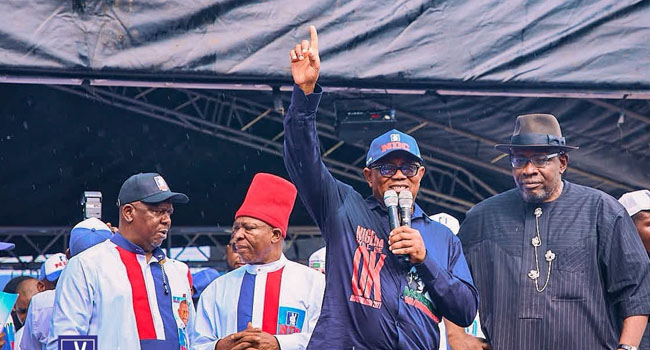
Obi, the Nigeria Democratic Congress (NDC) presidential candidate, visited the state alongside the party’s National Leader, Senator Seriake Dickson, for the commissioning of the party’s state secretariat in Yenagoa.
The visit also featured engagements with political stakeholders and a traditional Ijaw war canoe and boat regatta in Toru-Orua, Sagbama Local Government Area.
Speaking on the political implications of the visit, Professor Benjamin Okaba, immediate past President of the Ijaw National Congress (INC), said it had introduced a new dimension to Bayelsa’s political landscape.
Okaba, however, warned that political affiliations should not undermine the Ijaw people’s shared identity and aspirations.
He said political parties must be judged by their policies, credibility, and commitment to public welfare rather than their structures or prominent personalities.
The former INC president called on the NDC, the ruling All Progressives Congress (APC), and other political parties to focus on addressing challenges facing Bayelsa and the wider Niger Delta.
He identified environmental degradation, poor infrastructure, unemployment, insecurity, inadequate healthcare, and education as major concerns requiring urgent attention.
Okaba also called for the development of the proposed Agge seaport and greater investment in the region’s maritime, agricultural, fisheries, and tourism sectors.
He proposed an Ijaw Development Compact involving political parties, traditional institutions, elected officials, civil society groups, and youth organizations to establish measurable development priorities and hold leaders accountable.
He warned Ijaw politicians against allowing the 2027 elections to deepen divisions within the ethnic group, stressing that the region’s collective interests should come before party loyalty.
Also commenting on Obi’s visit, lawyer and former Movement for the Survival of the Ijaw Ethnic Nationality in the Niger Delta (MOSIEND) spokesman, Amaebi Clarkson, described it as significant and strategic.
Clarkson said the traditional reception accorded Obi could strengthen his political appeal in Bayelsa and the wider South-South region.
He also suggested that the visit could attract support from the large Igbo population in Yenagoa.
Despite the growing political activities ahead of 2027, Okaba maintained that the priority should be identifying leaders and parties capable of translating the region’s natural resources into improved living conditions for its people.